A locations index
One page linking to every location, kept current as locations open or close.
Multi location restaurant websites earn their keep when every address has its own page with its own hours, phone number and menu differences, because a single blended page cannot rank for a "restaurant near me" search at more than one location at the same time.
What it costs
The site structure starts with a locations index listing every address, linking to a dedicated page for each one. Every location page carries its own hours, phone number, directions and any menu differences specific to that spot, so a search or a guest arriving at that page sees information built for that exact restaurant rather than a generic overview.
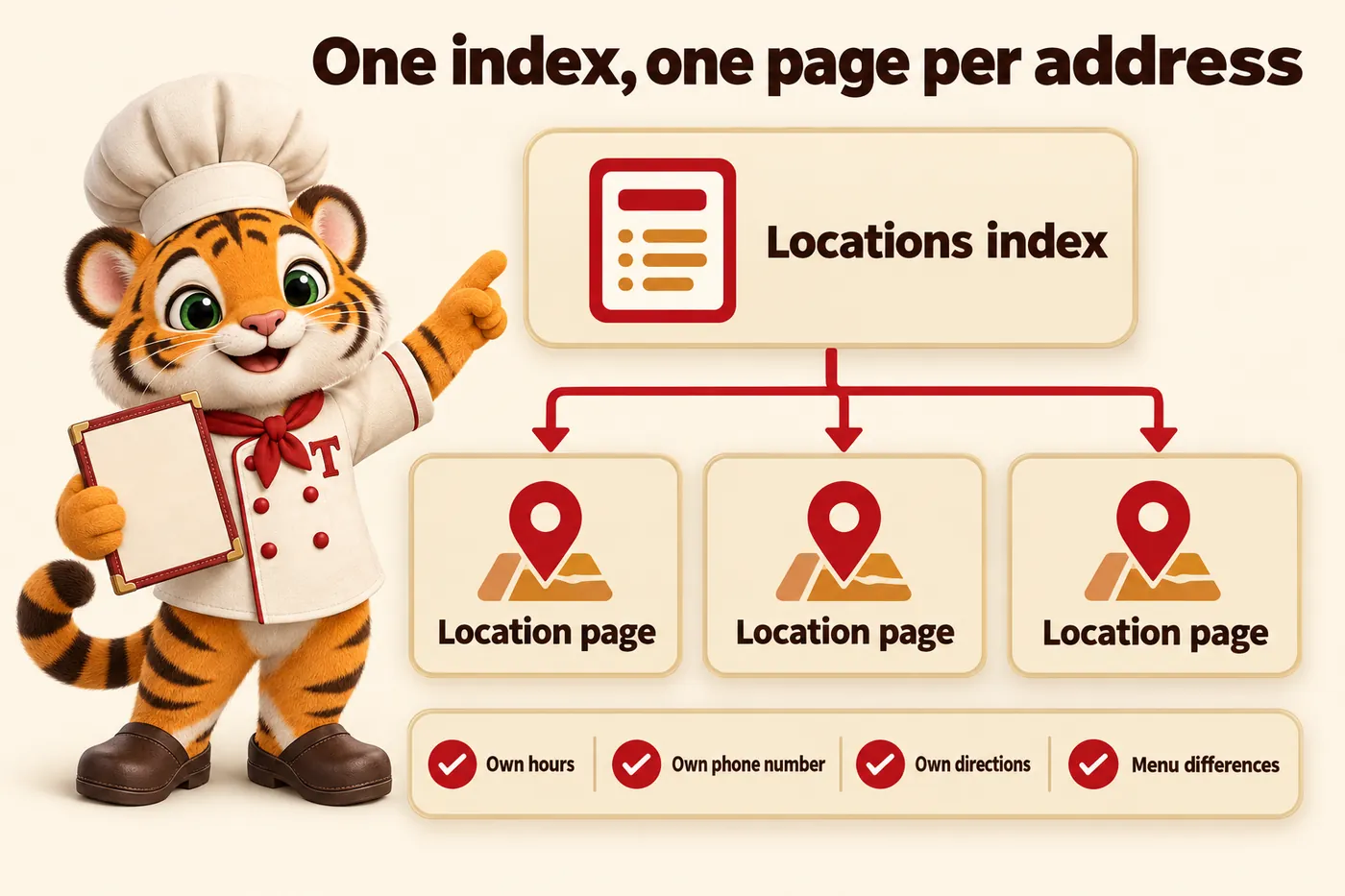
Most multi-location groups run one core menu with small differences between locations, a patio at one, no delivery at another, a lunch special only served downtown. We build the shared menu once and layer per-location notes on top, so you are not maintaining several fully separate menus when only a few items actually differ.
Search engines cross-check your name, address and phone number across the pages that mention each location. Keeping those details consistent between the site, the locations index and each individual location page is part of how local search treats every address as a legitimate, distinct listing rather than a duplicate or an inconsistent one.
Opening a new location does not require rebuilding the site. A new location page follows the same structure as the existing ones, with its own hours and menu notes, and slots into the locations index alongside the rest. Adding a location page is handled as a revision within your plan.
One page linking to every location, kept current as locations open or close.
Its own hours, phone number, directions and menu notes for each location.
One menu maintained centrally, with differences flagged where they exist.
The same core details kept accurate across every page that mentions a location.
Catering or contact forms routed by location, by department, or both, into your CRM.
Adding a location page follows your existing plan rather than requiring a new project.
Getting the restaurant reservations wording right mattered more to us than any visual choice. It explains what an inquiry achieves and is honest about what still needs a proper discussion. The awkward 'that's not quite what we meant' conversation has largely disappeared.
The question 'who is answering this one?' used to hang over every restaurant reservations inquiry. Every inquiry arrives with an owner, a status, and the context attached. The website and our way of working finally match.
Case files
Real projects, written up with the restaurant: where it started, what we built, how long it took and what changed on the floor.
Ten comparison pages put a managed build beside the options a restaurant usually weighs up, and each one says plainly when the other choice is the better fit. Two that often come up alongside multi location restaurant websites: Squarespace and Hiring a freelancer.
See all ten comparisonsYes, that is the structure we recommend and build. Each address gets its own page so it can rank independently for searches near that location, alongside a locations index that lists them all.
Yes. We build one core menu maintained centrally and layer per-location notes on top for the items or details that genuinely differ, rather than maintaining several fully separate menus.
Forms can be built to route by location, by department, or both, into your CRM by API, Zapier or Make, so a catering request for one address reaches the right team rather than a shared inbox.
A new location page is handled as a revision within your existing plan. Five revisions are included every month with no size limit on any one of them, so a full new location page counts as one revision.
Search engines cross-check those details across the pages that mention each location. Keeping them consistent is part of how each address is treated as a legitimate, distinct listing in local search rather than a duplicate.
A live walk-through of the site you would get, in about 30 minutes. Plans from $117 a month, the $647 build fee invoiced only after launch, domain and hosting included.
Book a demoOr email and a person replies within one working day.
GetRestaurantWebsite uses the cookies below. Necessary cookies keep the site working and cannot be turned off.
Saved on this device only. Press Esc to close.